Futurebetter blog
Tools for Systems Change: Listening Triads
Listening Triads are a powerful tool for encountering everyone's ideas
Alice Huntley
·
4 min read
Another in my mini-series on tools for systems change: Listening Triads.
How good are you at listening? Do you know how to look for what is really being said? Do you know what it's like to be properly listened to?
System change requires deep listening. At Futurebetter we believe in participative leadership, which is to say that wide participation in developing solutions for the future is necessary, and everyone involved in your project has something useful to contribute. It is the role of good facilitation (or good "hosting") to draw this out.
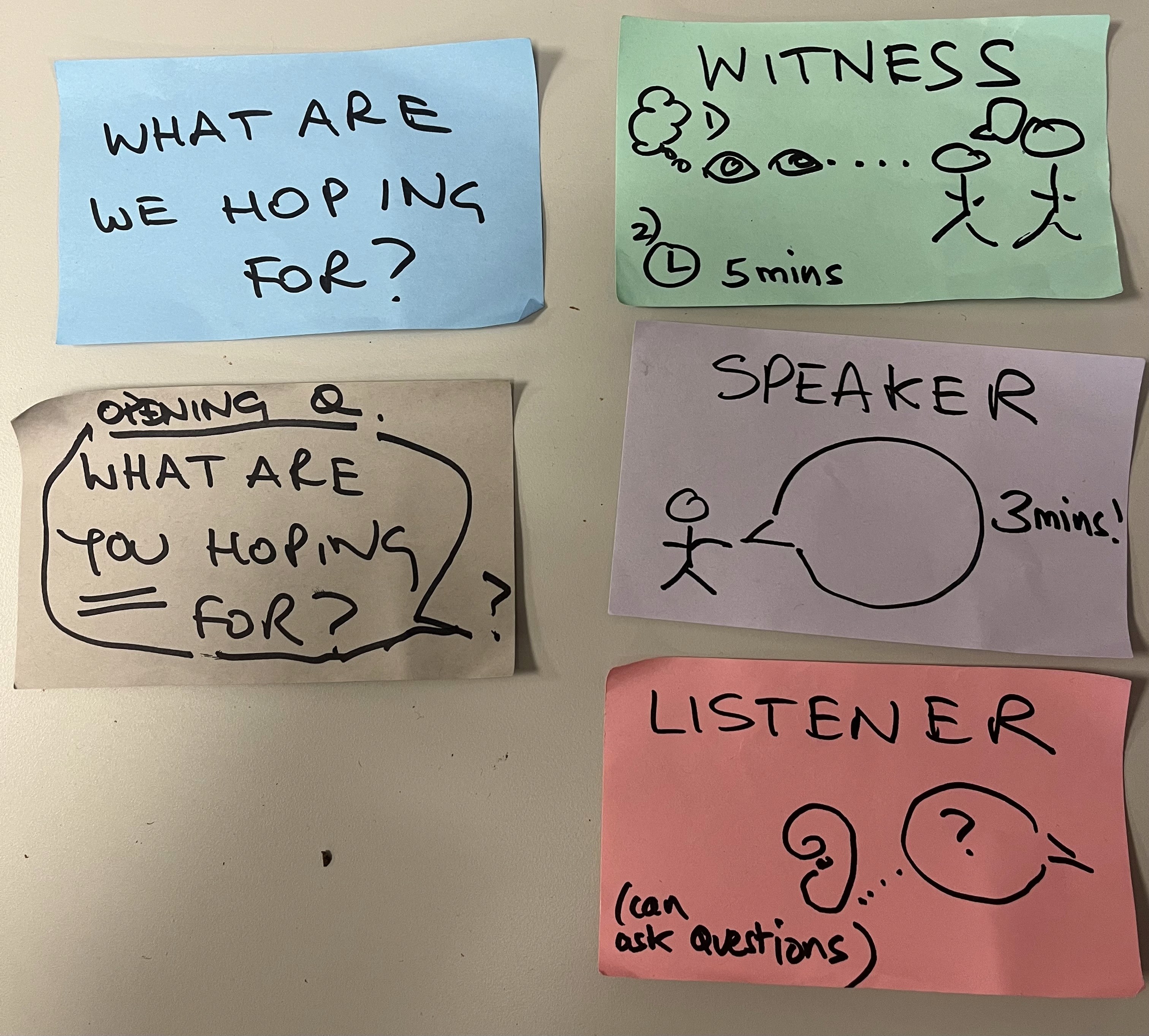
This simple breakout practice might just transform your projects. I've used it in a number of contexts, including a community rewilding project where a large number of people needed to come together around a shared sense of vision and purpose in a short space of time. The post-its in the image above show how I introduced the task to the group. My bad drawings of ears and speech bubbles were all part of helping people feel comfortable with who they are and what they have to bring. Also, truthfully, I can't really draw ears very well. I first encountered it on an Art of Hosting training week in Sasto, Hungary, highly recommended for anyone wanting to go deeper in this space.
How it works
Set a single overarching reflective question for the whole group, then split people into triads. Each person takes a turn in each of three roles: speaker, questioner and witness.
A good question might be "what are you hoping for?" (in relation to the project you're working on).
The speaker's role is to speak, if they want to.
The questioner's role is to listen, and ask a prompt question only if one genuinely occurs to them, not to lead or steer.
The witness keeps time, stays silent during the exchange, and reports back afterwards on what they noticed about the interaction that just took place.
Each round runs to a simple rhythm: 3 minutes for the speaker to speak, then 2 minutes for the witness to reflect back what they noticed. Then all three switch roles. Run this three times so everyone experiences speaker, questioner and witness. Art of Hosting typically recommend you allow between 5-15 mins for each speaker, depending on how much time you have. The whole exercise can take as little as 20 minutes, but ideally allow 45-60.
You'll be amazed at the power of being witnessed, and of what the witness notices. It could be the body language, what was said, how it was said, what wasn't said, where the 'energy' was, or the emotion: or just the pleasure of being able to really pay attention - of taking the time, human-to-human, to listen deeply.
You can run this online - it still works well - but it's a much richer experience in person and therefore excellent for team building and strategy away day sessions.
Why it works
This practice builds cohesion and shared purpose, and gives quieter people in the group time to express their most interesting (and deeply-felt) ideas without competing for airtime in a larger group setting. Don't be afraid to use emotional language in how you frame the question. People's ideas are best when they bring their whole selves to a problem: emotional, physical and intellectual, not just the analytical part most meetings ask for.
Get in touch if you're curious how to use Listening Triads to help unlock solutions in your own project.
Futurebetter blog
Tools for Systems Change: Listening Triads
Listening Triads are a powerful tool for encountering everyone's ideas
Alice Huntley
·
4 min read
Another in my mini-series on tools for systems change: Listening Triads.
How good are you at listening? Do you know how to look for what is really being said? Do you know what it's like to be properly listened to?
System change requires deep listening. At Futurebetter we believe in participative leadership, which is to say that wide participation in developing solutions for the future is necessary, and everyone involved in your project has something useful to contribute. It is the role of good facilitation (or good "hosting") to draw this out.
This simple breakout practice might just transform your projects. I've used it in a number of contexts, including a community rewilding project where a large number of people needed to come together around a shared sense of vision and purpose in a short space of time. The post-its in the image above show how I introduced the task to the group. My bad drawings of ears and speech bubbles were all part of helping people feel comfortable with who they are and what they have to bring. Also, truthfully, I can't really draw ears very well. I first encountered it on an Art of Hosting training week in Sasto, Hungary, highly recommended for anyone wanting to go deeper in this space.
How it works
Set a single overarching reflective question for the whole group, then split people into triads. Each person takes a turn in each of three roles: speaker, questioner and witness.
A good question might be "what are you hoping for?" (in relation to the project you're working on).
The speaker's role is to speak, if they want to.
The questioner's role is to listen, and ask a prompt question only if one genuinely occurs to them, not to lead or steer.
The witness keeps time, stays silent during the exchange, and reports back afterwards on what they noticed about the interaction that just took place.
Each round runs to a simple rhythm: 3 minutes for the speaker to speak, then 2 minutes for the witness to reflect back what they noticed. Then all three switch roles. Run this three times so everyone experiences speaker, questioner and witness. Art of Hosting typically recommend you allow between 5-15 mins for each speaker, depending on how much time you have. The whole exercise can take as little as 20 minutes, but ideally allow 45-60.
You'll be amazed at the power of being witnessed, and of what the witness notices. It could be the body language, what was said, how it was said, what wasn't said, where the 'energy' was, or the emotion: or just the pleasure of being able to really pay attention - of taking the time, human-to-human, to listen deeply.
You can run this online - it still works well - but it's a much richer experience in person and therefore excellent for team building and strategy away day sessions.
Why it works
This practice builds cohesion and shared purpose, and gives quieter people in the group time to express their most interesting (and deeply-felt) ideas without competing for airtime in a larger group setting. Don't be afraid to use emotional language in how you frame the question. People's ideas are best when they bring their whole selves to a problem: emotional, physical and intellectual, not just the analytical part most meetings ask for.
Get in touch if you're curious how to use Listening Triads to help unlock solutions in your own project.
Futurebetter blog
Tools for Systems Change: Listening Triads
Listening Triads are a powerful tool for encountering everyone's ideas
Alice Huntley
·
4 min read
Another in my mini-series on tools for systems change: Listening Triads.
How good are you at listening? Do you know how to look for what is really being said? Do you know what it's like to be properly listened to?
System change requires deep listening. At Futurebetter we believe in participative leadership, which is to say that wide participation in developing solutions for the future is necessary, and everyone involved in your project has something useful to contribute. It is the role of good facilitation (or good "hosting") to draw this out.
This simple breakout practice might just transform your projects. I've used it in a number of contexts, including a community rewilding project where a large number of people needed to come together around a shared sense of vision and purpose in a short space of time. The post-its in the image above show how I introduced the task to the group. My bad drawings of ears and speech bubbles were all part of helping people feel comfortable with who they are and what they have to bring. Also, truthfully, I can't really draw ears very well. I first encountered it on an Art of Hosting training week in Sasto, Hungary, highly recommended for anyone wanting to go deeper in this space.
How it works
Set a single overarching reflective question for the whole group, then split people into triads. Each person takes a turn in each of three roles: speaker, questioner and witness.
A good question might be "what are you hoping for?" (in relation to the project you're working on).
The speaker's role is to speak, if they want to.
The questioner's role is to listen, and ask a prompt question only if one genuinely occurs to them, not to lead or steer.
The witness keeps time, stays silent during the exchange, and reports back afterwards on what they noticed about the interaction that just took place.
Each round runs to a simple rhythm: 3 minutes for the speaker to speak, then 2 minutes for the witness to reflect back what they noticed. Then all three switch roles. Run this three times so everyone experiences speaker, questioner and witness. Art of Hosting typically recommend you allow between 5-15 mins for each speaker, depending on how much time you have. The whole exercise can take as little as 20 minutes, but ideally allow 45-60.
You'll be amazed at the power of being witnessed, and of what the witness notices. It could be the body language, what was said, how it was said, what wasn't said, where the 'energy' was, or the emotion: or just the pleasure of being able to really pay attention - of taking the time, human-to-human, to listen deeply.
You can run this online - it still works well - but it's a much richer experience in person and therefore excellent for team building and strategy away day sessions.
Why it works
This practice builds cohesion and shared purpose, and gives quieter people in the group time to express their most interesting (and deeply-felt) ideas without competing for airtime in a larger group setting. Don't be afraid to use emotional language in how you frame the question. People's ideas are best when they bring their whole selves to a problem: emotional, physical and intellectual, not just the analytical part most meetings ask for.
Get in touch if you're curious how to use Listening Triads to help unlock solutions in your own project.